
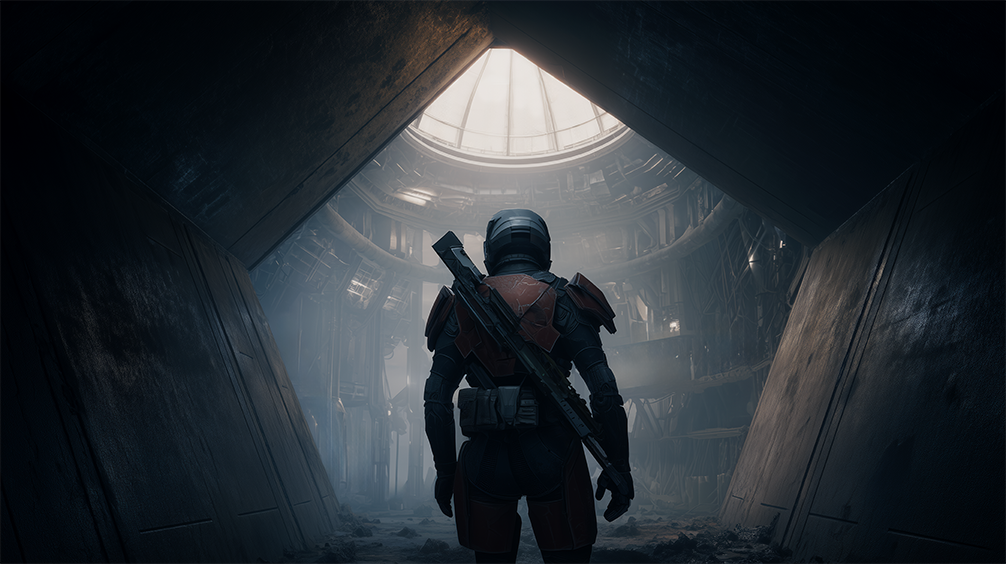
IT’S THE REASON YOU’RE STILL ALIVE.
Your fighter has 8 hit points. The enemy rolls 9 damage. She dies. Now enter the TTRPG armor system
That’s the sentence that broke D&D for me — not because it’s wrong, but because the fix is wrong. The fix is: give her 80 hit points. Give her 150 at level 15. Make her a sponge. Make the math work by inflating the numbers until a single sword swing becomes a rounding error.
Sol Fracta doesn’t do that.
In Sol Fracta, your Vital Energy sits somewhere between 0 and 10. That’s it. That’s your life. It doesn’t grow. It doesn’t scale. It doesn’t reward grinding. A veteran mercenary and a fresh colonist share roughly the same fragile human body, because that’s what bodies are.
And damage rolls 1d10. Minimum -1. Maximum -10. Average somewhere around -5 or -6.
Do that math. Without armor, one bad roll ends the session.
So we built a ttrpg armor system to mean something
Not “+2 AC.” Not “damage reduction 3/-.” Armor as a literal wall between your character and death. A tactical vest absorbs 4 points. Combat armor absorbs 6. Exo-armor, 8. Heavy armor, 10. When the damage coming in is less than or equal to what your armor can take — you feel nothing. Zero EV lost. The armor ate it.
When the damage exceeds the armor’s capacity, it absorbs what it can and breaks down a tier. You take the rest.
Here’s Laïs in two turns, EV at 6.
Turn 1: 7 damage incoming. Her combat armor (ND 6) absorbs 6, she takes 1. Armor degrades from D6 to D4. She’s at 5 EV.
Turn 2: 8 damage incoming. The cracked armor (ND 4 now) absorbs 4, she takes 4. Armor: ND 2. She’s at 1 EV.
Two turns. If she’d walked in without armor, she’d be at -13. Incompatible with life.
The table’s narration: “Your chest plate detonates in fragments. Without it, you’d have died twice.”
That’s the design philosophy in one sentence.
I wanted health to feel fragile. I wanted it to feel lethal. Because in the fiction we’re building — colonial frontiers, factional warfare, hostile environments — people wear heavy armor and plating because they want to keep breathing. Not as an aesthetic choice. As a survival imperative.
The system should reflect that.
What surprised me, working through this, is what happens emotionally at the table when armor becomes this load-bearing. Players stop seeing it as a number. They start seeing it as a character. The cracked chest plate from turn 1 — they’re already calculating whether they can afford to fix it before the next engagement. The repair costs. That’s a real decision. That’s the colony’s materials budget against their survivability.
And when an armor holds? When a 9 rolls against a 10-cap piece and the math works out perfectly? The exhale around the table is audible. Not because the character is powerful — because the armor did exactly what it exists to do.
One more wrinkle: executions.
Vulnerable target: auto-10 damage. Even heavy armor crumbles. Even the most protected character on the field gets destroyed in one move if they’re caught exposed. There’s no HP buffer to absorb that. There’s no tank mechanic to shrug it off. You either had protection, or you didn’t.
This is intentional. Lethal worlds don’t reward complacency. They reward preparation.
The contrast to traditional RPGs is starker than it might look from the outside. In D&D, armor makes you harder to hit. HP makes you harder to kill. The two systems work together to keep high-level characters functionally invincible against low-level threats.
In Sol Fracta, armor is not a modifier. It’s a sacrifice layer. It takes the hit so you don’t have to. When it breaks, it’s gone — and so is the buffer between you and a number your body can’t absorb.
There’s something I find more honest in that. The fiction of heavy armor isn’t “you’re harder to wound.” It’s “that thing on your chest took a round that would have gone through your sternum.” The system should say that out loud.
Ours does now.
Thank you for the inspiration Mörk Borg, Zero Year Engine and especially my player Nicow.
When you experiment with a TTRPG armor system what do you seek? What do you want to feel? Which one do you prefer? Why? Is there a TTRPG armor system not seen in the niche that you want to build or test?
SOL FRACTA // IN DEVELOPMENT
Join the Future Signal.
No release date yet. But when something moves — you’ll know first.

 English
  French
Laisser un commentaire