
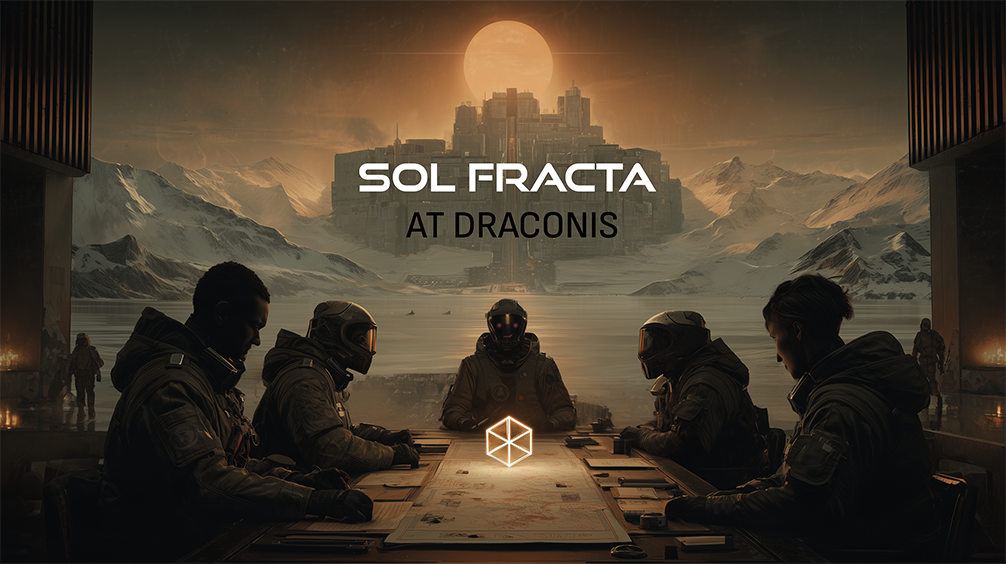
Sci-Fi TTRPG Playtest: Two Tables at Festival Draconis
“Do I know him? Who is he to me?”
She was playing James Fay, the Merco Prime officer, and she had a hard decision to make about an NPC. I told her to roll. Six to ten, he’s a comrade: you’ve shared some great times, you’re close. One to five, you couldn’t care less.
She rolled. She couldn’t care less. The table laugh.
That was one moment from two tables of Sol Fracta at Festival Draconis, on October 16 and 17 in Montréal. Eight players, four Pioneers, three to four hours each time, and a single d10 system. The Quickstart is still in production. I brought the game anyway: show it now, rather than wait until everything is perfect.
Two tables later, I understand a little better what makes a TTRPG easy for new players.
The Festival
Festival Draconis is a free roleplaying festival in Montréal, run entirely by volunteers. Every year it hosts about a hundred games, from D&D and Call of Cthulhu to recent independent games, local creators included. Sol Fracta was one of the local ones.
I ran La Mine de Calvaire, the mine scenario from the Quickstart. A cold colony of 521 people, a winter three cycles away, and a silent mine: the one that keeps everyone warm. The session was built around the characters. With three to four hours per table at most, the colony system only got a light touch. Both tables count toward the closed beta, which makes this a sci-fi TTRPG playtest as much as a demo.
On the table: the four Pioneer sheets in print, some illustrations, the mine map as an in-world handout, and my GM screen. Each player picked a Pioneer: Laïs Zihi of the Ordo Crucis, Cyril Raqa of the Horizon Syndicate, James Fay of Merco Prime, or Robert Zu Lee of the Deep Society.
Friday, 7 PM
Robert Zu Lee went to a new player. Robert is “a man of knowledge, solutions, and secrets,” and his sheet carries a few lines on how to play him: which Essence and which Skill to reach for when he needs to teach, to destroy, or to take a risk.
That was enough. He knew what to do.
Saturday, 1 PM
Four other players, same mine. Cyril Raqa, the networker, went to someone playing their third game. They found the sheet simple to use too.
At both tables, the same thing kept coming back: players loved how fast a roll resolves, and how hard it hits. Both also brought up Dungeons & Dragons and fights that run too long. To me, that makes Sol Fracta a complement: something that strengthens the hobby rather than replacing anything in it.
And both reached the end at the same point. In hindsight, I stuck to my timing when I could have followed each table’s feel, and given them two drastically different endings. After that, both tables watched their choices play out on the factions and the colony, and got a glimpse of what the game becomes after the mine.
What the Tables Changed on the Sheet
Two changes came straight from those tables. On the four Pioneer sheets, the Essences are now written out in full instead of abbreviations: Biological, Psychological, Social, Cultural, Existential. And the equipment dice will become a die icon with the number on it, instead of “D6”.
The tables also led to a few tweaks in the scenario. Those stay with us. You’ll play them without knowing which ones they are.

English version will come along the French version.
What Comes Next
Players scanned a QR code and went to the site on their own, with no form and no follow-up. That’s deliberate: bring people in, without pushing.
The character side is ready. The next challenge is the colony, and how far its cognitive load can come down. I just got back from a Warhammer game with friends, and the inventory management there is too heavy for most people new to roleplaying. What I want for Sol Fracta is a colony tool that’s fun for GMs and players, with the right balance between fun and tactics, and as little spreadsheet managing as possible.
The Quickstart is coming along well. When it’s out, you’ll play the same mine. With Draconis, the closed beta now stands at 4 tables and 14 players. The alpha, now complete, ran 6 tables and 21 players, with 97% retention.
If you sat down at our next sci-fi TTRPG playtest, how much of the colony would you want on your plate?
What makes a TTRPG easy for new players at your table?
SOL FRACTA // EN DÉVELOPPEMENT
Rejoins le Futur Signal.
Date de sortie inconnue. Mais dès qu'il y aura du nouveau, tu seras dans les premiers informés.

 French
 English
Laisser un commentaire