
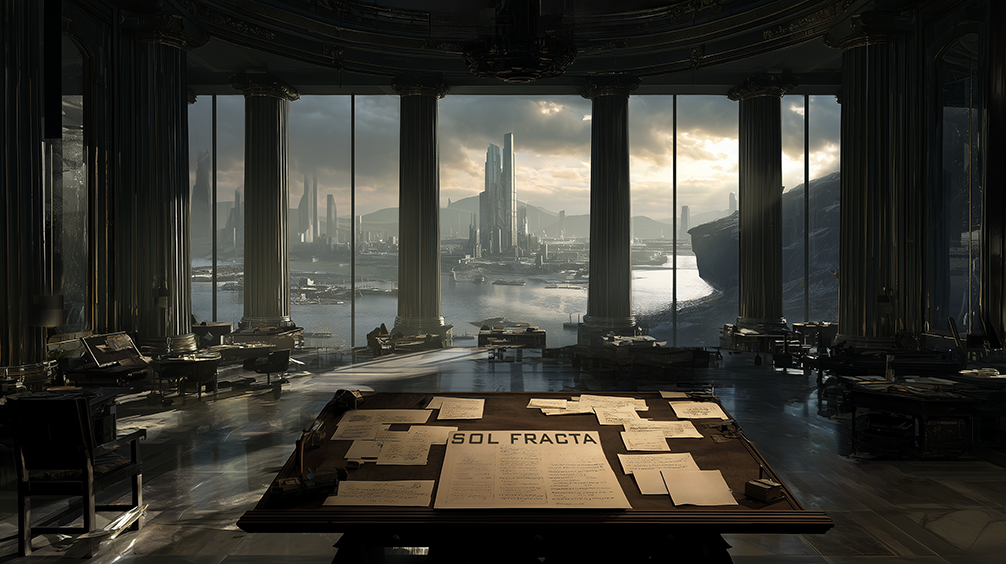
Most Didn’t Make It.
TTRPG Character Sheet Design: The Two-Question Filter
When we started building the Sol Fracta character and colony sheet, we had a long list of things that should be on it. Population of the colony. Reference prices for gear. Reputation gauges for each faction. A free-text block for personality notes.
None of them made the final cut. And it wasn’t because we ran out of space.
It’s because none of them could answer two questions.
The test is simple: Good JDR character sheet design isn’t about what feels thematic. Not by existing in other games. It earns its place by doing one of two things at the table:
Does it generate a decision?
Does it generate an emotion?
If the answer is no to both, the element either lives somewhere else or disappears entirely.
That’s it. That’s the filter.
It emerged first while I iterated the system with AI and second from watching what players actually did with the sheet during playtesting. Population was on an early version with AI, it made sense narratively, it’s a survival colony, of course you’d track how many people are alive. It just sat there, inert, a number that updated between cycles and changed nothing at the table. While you imagine what it will do in the long run and the headache it would provide. Big no. Gone.
Reference prices for gear had the same problem. Useful information, but it belonged in the colony sheet or a quick-ref handout, not on a character’s page. Accessing it there generated neither a decision nor a reaction, it generated a lookup. Different thing entirely.
Reputation gauges were trickier to cut. The design impulse was real: factions matter in Sol Fracta, your standing with them should be visible. But static gauges: “you’re at 6/10 with Merco Prime”, don’t create moments. They describe history. What creates moments is when you have to choose who you’re loyal to when it costs you something. That mechanic lives in the system. The gauge was just decorating it without adding anything.
That observation told us something we hadn’t expected: friction matters. Even a small amount of friction determines whether an element gets used.
Here’s where I want to push back on a misread of “rule-lite” that I see often: the assumption that fewer elements means a shallower game.
Sol Fracta has resources. It has a currency system. It has five (ten) factions with competing agendas. It has a historical registry that tracks what the colony has done across sessions. It has Essences, skills, gear, augmentations, a vitality system that doubles as an economic resource.
Every single one of those elements passed the test.
The Essences (Biologique, Psychologique, Sociale, Culturelle, Existentielle, Astrale) aren’t on the sheet because they’re cool sci-fi categories. They’re there because when you ponder how each layer constructs your character. It generates emotion.
Énergie Vitale is there because spending it is a decision with consequences that ripple through the session. Gear is there because each item is a choice vector and is the signature of your character. Specificity is there because when players look at it, they’re figuring out what makes their lineage unique.
Everything else was cut. Not because we were lazy. Because we were ruthless.
After six playtests, not a single player found the character sheet overwhelming. Newcomers to TTRPGs picked it up within the first 15 minutes. A few called it innovative, which honestly caught us off guard, we weren’t trying to be novel, we were trying to be honest about the system we were building and what actually mattered at the table.
The test didn’t start as a principle. It became one because it kept working.
Now it’s the first question we ask whenever we’re tempted to add something. And the answer is “no” more often than it’s “yes.”
If you design TTRPGs, or any kind of game with player-facing documents, here’s the version you can steal:
- Does this element generate a decision?
- Does this element generate an emotion?
- If neither: does it live better somewhere else, or does it just go?
No shame in cutting. The shame is in keeping things that sit inert, taking up space, adding visual noise without adding value.
What’s the last thing you cut from a design that you were sure would stay?
What’s your approach to TTRPG character sheet design, do you test each element against what it generates at the table, or does it earn its place differently?
SOL FRACTA // EN DÉVELOPPEMENT
Rejoins le Futur Signal.
Date de sortie inconnue. Mais dès qu'il y aura du nouveau, tu seras dans les premiers informés.

 French
  English
Laisser un commentaire