
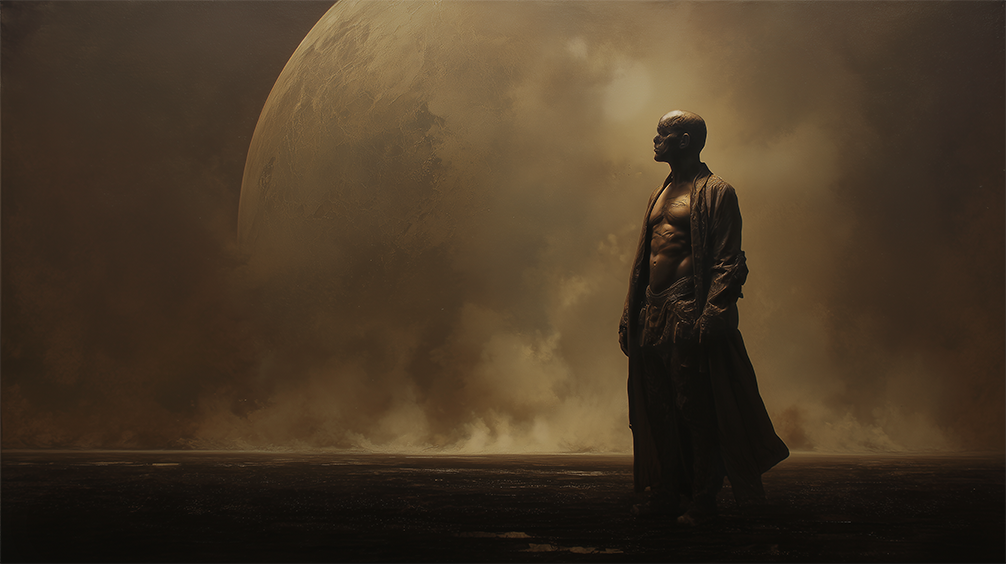
That’s not a tagline. It’s the mechanical logic behind Specificities in Sol Fracta, and it took us a while to trust it.
TTRPG Generational Progression: When Death Is the Price of the Next Tier
We Almost Made Them Double-Edged
The first instinct was to design Specificities the way scars work in fiction: something that makes you stronger in one domain and more fragile in another. A trait forged by a difficult history should carry weight in both directions. We sketched versions with built-in risks, narrative costs, mechanical downsides baked into the bonus.
Then we stopped and looked at what was already there.
The cost was already in the system. It’s the generational death itself. You don’t pay for the next tier with a disadvantage embedded in the trait. You pay with your character. That’s a heavier price than any malus, and it doesn’t need to be stated twice. Once we saw that, the rest became simple: keep the traits clean. Let the system do the work.
One Trait, Three Generations
Each character carries one Specificity. It has three tiers. The only way to reach the next tier is to lose the person who carried it: death, retirement, passing the torch. What a Gen 1 character started, a Gen 2 heir deepens, and a Gen 3 heir brings to full expression.
The progression pattern across all four pregenerated characters follows roughly the same arc: what the lineage learned to do for itself, it slowly learns to do for others. Individual, then one ally, then the whole group or maybe the colony. Three tiers, three generations, one unbroken thread.
The Four MVP Specificities in Action
Robert Zu Lee (Deep Society) carries Flamme Intérieure. At Tier 1, he ignores the effect of his first fatigue point, the second still hits full force. It’s the resilience of someone trained to push past the first wall, nothing more. At Tier 2, the lineage has learned to transmit what it knows how to absorb: once per cycle, he extends that resistance to one ally for a scene. At Tier 3, his presence alone is enough. All allies in the scene ignore their fatigue point for one roll each. A personal threshold becomes a field that covers everyone around him.
Laïs Zihi (Ordo Crucis) carries Écho du Collectif. Tier 1 is straightforward: +1 EA per cycle, personal use. At Tier 2, that point can be injected into the collective pool instead of kept. The choice belongs to the player each cycle. At Tier 3, once per arc, the next EA use by the group produces two effects for the price of one. A trait that began as individual spiritual sensitivity eventually reshapes how the whole group accesses its most mysterious resource.
James Fay (Merco Prime) carries Maîtrise son Ombre, and it might be the most honest one. From Tier 1: +2 EXP on any critical failure. He learned from hitting bottom, so the system takes him literally and rewards it. At Tier 2, it’s +2 EXP but for any failure. At Tier 3, once per arc, he can cancel the consequences of a critical failure, personal or for an ally, it means that it can stop the disastrous EV cost of a critical failure. The person who survived the worst teaches others how to fall, and eventually the fall becomes survivable in a new way.
Cyril Raqa (Horizon Syndicate) carries Instinct du Pionnier. Once per cycle, before a roll, he justifies an advantage and gets it. At Tier 2 it can activate after seeing the result: relance, keep the best. At Tier 3 he can transform a failed roll, for him or an ally, to a flawless success. Frontier instinct that started as a personal read on a situation now shapes how the whole group navigates the unknown.
A Different Clock
Skills in Sol Fracta advance through failure, session by session. Essences advance through voluntary vulnerability, arc by arc. Specificities advance through generational loss, campaign by campaign, sometimes longer. It’s the slowest progression axis in the game, and deliberately so.
The question it puts on the table isn’t how to get better at something. It’s what this lineage will look like when the colony is old.
What TTRPG generational progression systems have you seen, in TTRPGs or anywhere else, that actually changed how your group thought about character death?
How do you handle character death at your table? Is it a reset, or does something carry forward into whoever comes next?
SOL FRACTA // EN DÉVELOPPEMENT
Rejoins le Futur Signal.
Date de sortie inconnue. Mais dès qu'il y aura du nouveau, tu seras dans les premiers informés.

 French
  English
Laisser un commentaire