
TTRPG Currency Design: The Case for Deflationary Money
Most tabletop RPGs treat currency like wallpaper. It’s there, it fills space, and nobody really thinks about it. You loot a dungeon, you buy a sword, you forget about it until the next shopping scene. The currency exists to justify the gear treadmill, nothing more.
Sol Fracta‘s TTRPG currency design started with a different question: what if the money meant something? What if it’s a system? What if it had lore, history, philosophy baked into its rules? What if killing someone for their wallet was actually a terrible economic decision? Moreover what if violence is not the most efficient tool in a TTRPG anymore?
The answer took nine months and three complete redesigns to find.
July 2025 — The Clock-Money Idea
The first version was called Chrono-Wealth Units. CWU. 21,000 per character, fixed forever.
The number wasn’t arbitrary. It was meant to represent a rough approximation of disposable life-hours, a nod to Austrian economics and the idea that time is the only resource that’s genuinely finite. You can’t earn more CWU. You can’t borrow them. You start with 21,000, and that’s it.
The interesting mechanic was what happened to prices. If your character successfully innovated, built something more efficient, solved a production problem, the market price for that category of goods dropped. Same wallet, cheaper world. Economic wins weren’t expressed in gaining money, they were expressed in your fixed money gaining purchasing power. Psychologically inverted from every RPG I’ve ever played.
Failures did double damage: you lost CWU and earned Failure Tokens, which fed the progression system. Losing money was mechanically meaningful. It wasn’t just a number going down; it was fuel for growth.
It was clever. It was also, ultimately, wrong for Sol Fracta.
The problem wasn’t the philosophy. It was the scope. CWU was a personal economy. Sol Fracta is a colonial economy. 500 settlers on a new world, factions competing for infrastructure control, robots doing automated labor, generational timescales. A per-character fixed wallet didn’t scale to that. And more practically: it created a closed loop where the macro never changed. If every character has the same amount forever, what does market evolution look like? What does a century of progress feel like, economically?
We threw it out. Not the reasoning, the mechanism.
January 2026 — Terra Horizon. 100 Million Units. One Colony.
The redesign started from the colony, not the character.
The question became: what does a colony’s money supply look like if you apply the same principles? Fixed supply, no inflation, productivity-driven value.
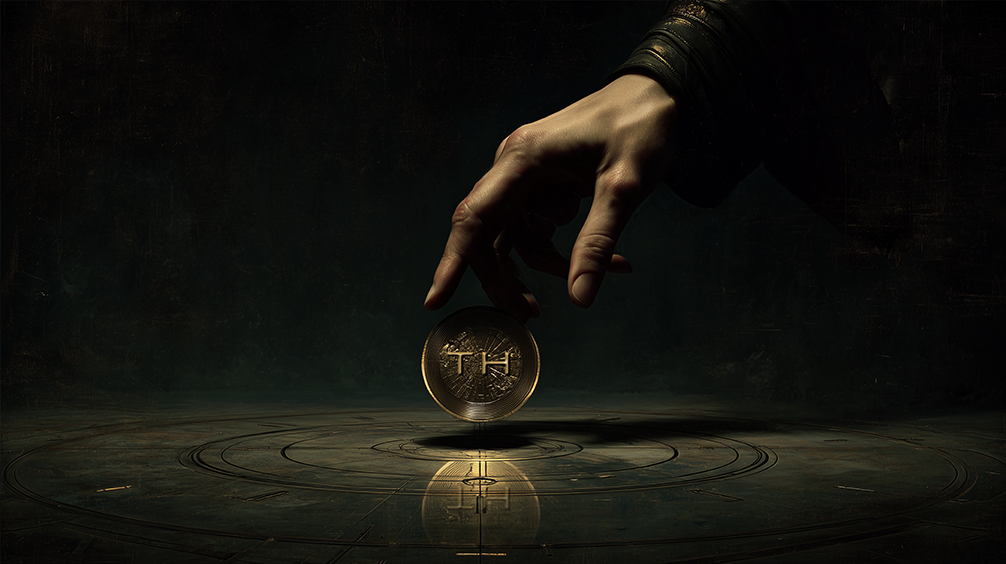
Terra Horizon (TH) was the answer. Each colony launches with exactly 100,000,000 TH inscribed in its protocol. Not one more, ever, unless 90% of the colonists vote to change the rules, a threshold that’s politically near-impossible in a fractured colonial environment. The supply is fixed not by decree, but by consensus math.
Half the supply, 50 million, distributes immediately. Every settler gets 100,000 TH on arrival. That’s their wage for agreeing to come. On a colony with no infrastructure, no markets, no established prices, that number is both enormous and meaningless. It’s money in a place where money hasn’t learned what it’s for yet.
The other 50 million mines progressively over roughly 1,000 years, about 50,000 TH per year, distributed between whoever holds TH-Core control shares. Ten shares, various owners, faction politics. Controlling energy means controlling future money production.
But the really interesting part is what happens to prices without touching a single rule.
Cycle 1-10. 50 million TH in circulation. Production capacity is primitive, inconsistent, barely above subsistence. A standard D6 sword costs around 25,000 TH. Almost a quarter of your entire starting allocation for a basic weapon. Money is abundant, goods are scarce. Classic early-colonial inflation by another name.
Cycle 100-500. 52 million TH circulating. Production has climbed. Factories exist, supply chains work, things are being made reliably. Same sword: 5,000 TH. The rules didn’t change. Prices did.
Cycle 1000-5000. 55 million TH. Production is massive. Industrial colony, centuries of development. That sword: 300 TH.
Cycle 10,000. Full 100 million TH (if ever reached). Automated factories. Same sword: around 30 TH.
The deflation isn’t programmed in. It emerges from the relationship between a fixed money supply and improving productive capacity. As colonies get better at making things, everything becomes cheaper in absolute terms. Your TH gains purchasing power as a natural consequence of progress. That’s not a game mechanic, that’s the Austrian School applied to a colony with a blockchain-style currency.
To my knowledge, no RPG has implemented this deliberately. Genuinely curious if someone can name one.
March 2026 — The Rules That Make It Real
The economic model was coherent. What it needed was teeth.
The problem with fictional economies is that players will always find the exploit. And the obvious exploit here is: kill someone, take their TH. If the supply is fixed, every death makes the survivors richer, right?
We closed that door completely.
Kill someone in Sol Fracta? Their funds are possibly gone forever. Not redistributed. Not lootable. Destroyed. Their coded bank account dies with them unless they transmitted the code before death. Their TH stick, a physical, anonymous storage device, only transfers if you physically possess it. Their assistant account goes dark and the biometric lock means access dies with the owner.
This isn’t just a design decision. It’s built into the lore. TH belongs to no institution, no government, no bank. It belongs to whoever holds the access. There’s no recovery mechanism because that would require a central authority, and TH’s entire existence is a rejection of central authority.
TH is the separation of Money and State.
The practical consequence: murder is a terrible investment. You kill a productive colony member, you lose their contribution to labor and resource generation, and their wealth exits the system permanently. You’re poorer. The colony is poorer. The only person who benefits is no one.
To actually steal TH, you need to work for it. Torture: opposed Will vs. Coercion, and you might get the code if they break, or they might die with it locked. Hack the assistant account: Cryptography skill, and it’s traceable, and you’re leaving a record in a Nexus-Core that someone, somewhere, will eventually find. Physical search: Investigation, and the TH Stick might not be where you think it is, or it might be in a place that costs more to reach than the 10,000 TH limit it holds.
“In Sol Fracta, killing someone doesn’t make you rich. It just removes money from the world.”
There’s also a slower, quieter deflationary force running in the background. Every forgotten code. Every TH Stick lost in a collapsed mine or a river crossing gone wrong. Every assistant destroyed without backup. These aren’t dramatic economic events, they’re the slow bleed of human fallibility applied to a fixed supply. Over centuries, the TH in active circulation naturally shrinks. The ones that remain are worth more. Every death has a macroeconomic footprint, even if nobody’s tracking it.
The Thing This Took Nine Months to Learn
The CWU prototype was asking “how do we make money philosophically interesting?” The TH system is asking “how do we make money tell the story of a colony across a millennium?”
Those are different questions, and they produce radically different designs.
CWU put the economy inside the character. TH puts the character inside the economy. Your individual wealth matters, but you’re operating inside a system with its own physics: productive capacity, supply curves, the irreversible loss of every death. The players feel that system even if they never see its equations.
The sword that costs 25,000 TH in Cycle 1 isn’t expensive because we wanted to make players struggle. It’s expensive because the colony doesn’t know how to make swords yet. When it costs 300 TH a century later, that’s not a price change, that’s a civilization.
That’s the version of money Sol Fracta was always trying to build. It just took a couple of wrong turns to find it.
One question I’m still thinking about: the deflationary model assumes that losing TH to death and accident is slow enough that it doesn’t cause economic contraction faster than productivity gains. But what happens to a young colony hit by a plague or a major disaster that kills 30% of the population at once? The math gets brutal fast. Is that a feature or a flaw? I genuinely don’t know yet.
What does your TTRPG currency design look like, and have you ever tried making saving more mechanically rewarding than spending?
SOL FRACTA // IN DEVELOPMENT
Join the Future Signal.
No release date yet. But when something moves — you’ll know first.

 English
  French
Leave a Reply