
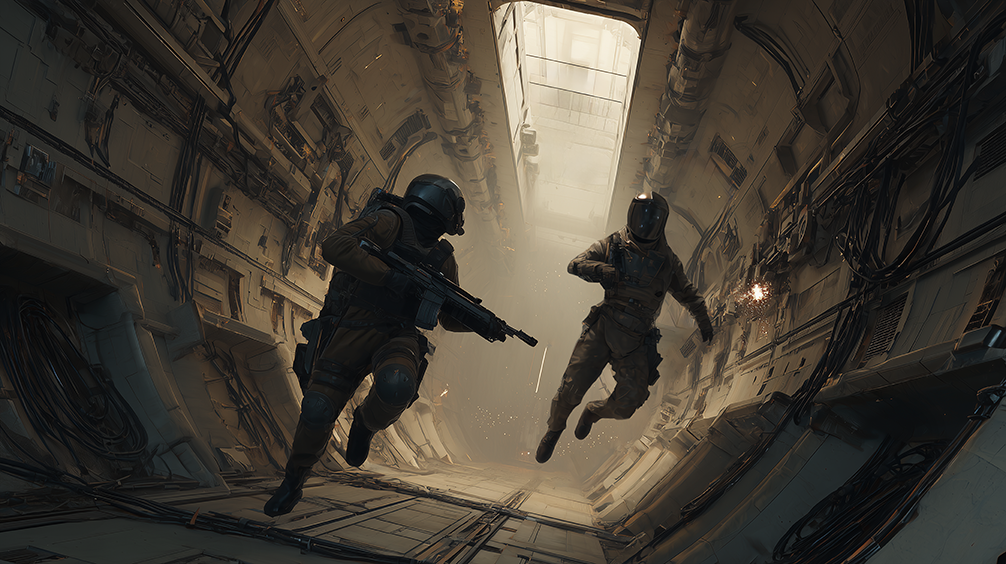
TTRPG Combat Dice Rolls: When Five Becomes Two
The playtest note that broke everything was six words long (6 in french).
“That’s a shit ton of dice rolls.“
That’s it. me and the digital intelligence, mid-session, watching Laïs charge into a firefight with a claymore and a propulsion rig, just… observing. And we were right. One action: one charge, one clash, had generated five separate dice rolls: success check, damage, armor, weapon wear, equipment wear. Five rolls. One moment of fiction.
I knew immediately something was wrong. The question was what, exactly.
The Problem Wasn’t Complexity. It Was Redundancy.
Here’s what bothered me more than the five rolls: they all felt justified in isolation. Damage matters. Armor matters. Equipment degradation matters : it’s a core loop of Sol Fracta‘s survival economy. If you asked me to defend any single roll, I could. But stacked together, they were doing the same thing five times: asking the player to pay attention.
Attention is the real resource at the table. Not hit points, not ammunition. Attention.
So the first question wasn’t how do we reduce rolls? It was what are these rolls actually for?
Three Iterations, Two Rejections
Iteration 1 came fast: merge damage and armor into a single d10. One roll, the number tells you both how much you deal and how much gets through. Clean on paper. Dead on arrival. It solved nothing about equipment wear, we still needed separate rolls for weapon and gear degradation. We’d gone from five to four. That’s not a solution, that’s arithmetic.
Rejected.
Iteration 2 was more interesting, and more revealing. What if wear was purely narrative: GM calls it based on fiction, not dice? Harsh fight? Your gear degrades. Clean victory? It holds. No roll.
The pushback from the playtest group was precise: “Que l’armure soit pas narratif et le reste oui est un peu étrange. Uniformise. Ou bien narratif ou bien random.”
“It’s a little strange that the armor isn’t narrative-based while the rest is. Standardize it—either make it narrative-based or random.“
Which is exactly right. If armor has a mechanical threshold and weapon wear is vibes, you’ve created two different design philosophies inside one system. Players can feel that inconsistency even when they can’t name it. It erodes trust in the rules.
Iteration 2 gave us something more valuable than a solution: a principle. Systemic coherence beats partial elegance. A slightly worse solution that feels consistent beats a slightly better solution that feels arbitrary.
Rejected. Principle retained.
Iteration 3 was the breakthrough, and it came from a simple reframe: “What if equipment has a stress threshold — D0, D2, D4, D6, D8 — and it downgrades when the roll exceeds it?”
That’s interesting. That’s stacking information onto existing rolls rather than adding new ones.
The Stacking Principle
Once we had that direction, the rest fell into place fast.
Armor doesn’t need its own roll. It’s a capacity. If incoming damage is equal to or below that capacity, it absorbs everything — full stop. In fact, for equal, there is no damage for the character but the armor downgrades. If damage exceeds capacity, armor absorbs up to its limit, the player takes the remainder, and armor downgrades one step. Zero additional rolls. The damage roll that already happened does all the work.
Weapons: same logic. The damage roll you’re already making? If it hits the weapon’s stress threshold, the weapon downgrades. The roll exists. Stack the consequence onto it.
Equipment: the action roll you’re already making? Same thing. If Laïs fires her propulsion rig and rolls a consequence, it can take wear. One roll, two outcomes.
The principle, written plainly: don’t ask if you CAN stack. Ask what roll already exists.
If a roll is happening for another reason, it can carry additional information. You’re not adding complexity, you’re extracting more signal from complexity you already have.
The Numbers
Laïs, first turn of combat. Before the redesign: 5 rolls. After: 2 rolls. Sixty percent reduction.
More importantly, here’s what those 2 rolls resolve:
Turn 1: Laïs charges. Action roll: 4. Success with a consequence. Damage roll (2D10): 9 against the opponent, 7 against Laïs. Armor cap at 6 absorbs 6, Laïs takes -1 EV, armor downgrades D6 → D4. Propulsion rig: consequence triggers, downgrades D6 → D4. Claymore: unbreakable by design. Two rolls. Enemy, dead. Three systems resolved.
That’s the target ratio. Two rolls, multiple cascading consequences, zero redundancy.
What We Didn’t Sacrifice
The equipment degradation loop is still there: fully mechanical, fully consistent. Armor still matters tactically. Weapons can still fail at the worst possible moment. The fiction is richer because the stakes are legible.
We didn’t simplify Sol Fracta. We compressed it. There’s a difference. Simplification removes information. Compression preserves it in a smaller container.
The playtest note that broke everything turned into the best design session we’ve had. Sometimes “this feels like too much” is the most precise feedback you can receive.
We’re running a real playtest session next weekend. Laïs is going to charge into something again. I want to see if the new system creates the same dramatic beat with half the friction.
My guess: it will. But that’s what the dice are for.
Me, from the future: it did.
How many TTRPG combat dice rolls does your system generate in a single action, and have you ever cut one that turned out to be load-bearing?
SOL FRACTA // IN DEVELOPMENT
Join the Future Signal.
No release date yet. But when something moves — you’ll know first.

 English
  French
Laisser un commentaire